
Reviewed · CITY TOURS
Ancient City Of PAPHOS
An Ancient City of Paphos tour is interesting because it turns Greek mythology into something you can stand next to, then keeps going into the real material traces of ancient life. I love the short stop at Aphrodite’s Rock, where people still head in to swim, playing into the legend in a very straightforward way. I also love how the guide often connects the sites to modern Cyprus context, including stories like the 1974 split explained by guides such as Sirin. One possible drawback is that the schedule is packed, so you will be moving at a “see the key parts” pace rather than a “wander for hours” pace.
This is built for convenience, too. You ride in a comfortable vehicle between Nicosia and Paphos with bottled water, a professional English speaking guide, and a mix of free-entry stops plus a couple of places where you may need to pay admission separately. If the weather is poor, the experience can be canceled or shifted, so keep flexibility in your plans.
Key things to know before you go
- A myth-themed anchor stop at Aphrodite’s Rock, with time to enjoy the beachside atmosphere
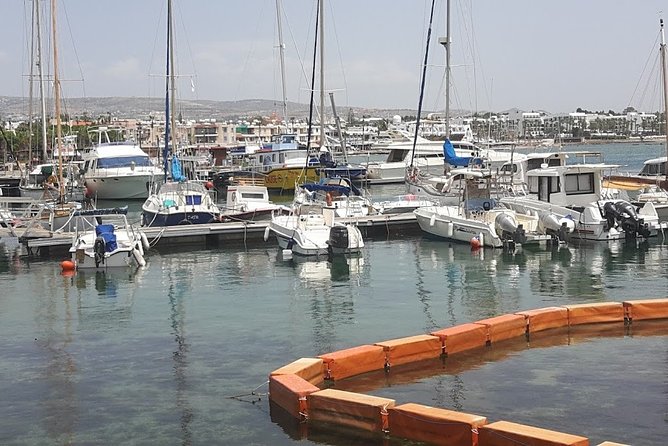
- Paphos Harbour on foot in a restored pedestrian area, plus a customs-house setting for views and browsing
- St. Paul and early church mosaics at Agia Kyriaki, including the pillar linked to his flogging story
- Tombs of the Kings scale and Doric-style stone columns, even though the “royal use” claim is uncertain
- Private group comfort with pickup options and only your group in the vehicle
- Good weather matters, since the itinerary is mostly outdoors
Why Paphos Works as a Myth and Archaeology Day Trip from Nicosia
Paphos is one of those places where stories and stones line up well. You start with the myth lane, then you get pulled into the archaeology lane, and the switch never feels random. Even if you are not chasing every single inscription, you can still see how the sites connect across time.
What makes the day especially satisfying is the mix of “front-row myth” and “solid remains.” Aphrodite’s Rock gives you a vivid, sensory moment. Then the harbour and the older church ruins bring you back to everyday anchors like ports, worship, and burial traditions. By the time you reach the mosaics and the burial site columns, you are not just looking at scenery. You are learning what people valued and how those choices survived.
And because this is a round-trip tour from Nicosia, you are not spending your trip budget on stress. You get transport, guidance, and a logical route instead of trying to stitch together separate tickets and timings on your own.
A few more Nicosia trips worth pricing up
- 3-hour Nicosia Segway Tour
★ 5.0 · 323 reviews - Nicosia: Green Line and Buffer Zone Guided Walk
★ 5.0 · 147 reviews - NORTHERN CYPRUS ALL-IN-ONE Private Day Trip from Nicosia
★ 5.0 · 89 reviews
Getting There: Ledra Palace Checkpoint, Private Groups, and a 9:00 Am Start
Your day starts at Ledra Palace Checkpoint in Lefkoşa. The tour begins at 9:00 am, and it returns you to the same meeting point at the end. That matters because it shapes your whole rhythm. You are committing to a full half-day outing, not a quick stop during the afternoon.
This is also set up as a private tour, meaning only your group participates. The price is listed per group, up to 4 people. In practice, that can be a smart deal if you are traveling as a small family or a couple of friends who would otherwise be paying separate taxi or car costs.
Pickup is offered. You will get a mobile ticket, and confirmation is sent within 48 hours of booking, subject to availability. Also note the “good weather” condition. If skies are rough, the operator may cancel or move the experience, so plan with some breathing room.
Stop 1: Aphrodite’s Rock, Foams, and the Real Reason People Keep Coming Back
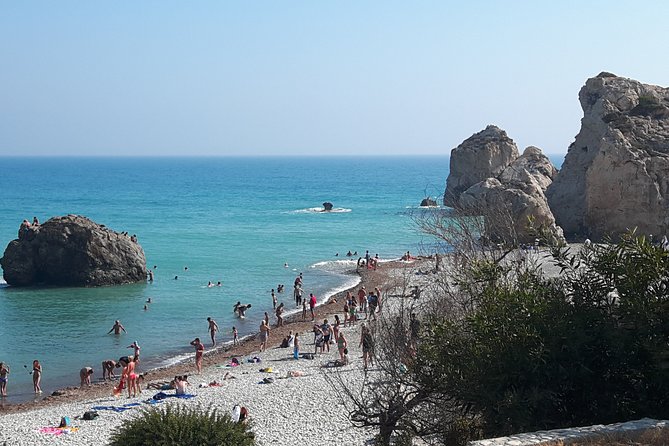
Aphrodite’s Rock is the myth hook for the whole day. The belief is that Aphrodite emerged from the sea foam here, so the site has a very “come see it and participate” energy. Your visit is about 45 minutes, and admission is free.
Here is the practical way to think about it. You are not going to get a long guided lecture in that time. Instead, you get a compact introduction to the legend, plus a chance to experience the atmosphere for yourself. The information you are given explains why visitors expect a little magic, including the playful idea that swimming could somehow connect you to Aphrodite’s beauty. Whether you treat the myth as poetry or take it more literally, you will understand quickly why the beach area attracts people.
A small heads-up: because this is a sea-side stop, you are at the mercy of weather. If it is windy, you will feel it. If it is calm, you will enjoy it more.
Stop 2: Paphos Harbour and Port, Restored Walkways and Easy Waterfront Time
Next you head to Paphos Harbour and Port for about 1 hour 30 minutes, and admission is free. This is where the tour shifts from myth to the infrastructure of the ancient world.
The harbour area was restored in the years 1992 to 1995, and it is pedestrian-only. That one detail makes a big difference for how enjoyable the stop feels. You can stroll, pause for photos, and browse without dealing with vehicle traffic. There is also a restored old custom house, and depending on the time of year you might find exhibitions happening there.
You will also notice the practical side of the harbour: restaurants clustered around the waterfront, plus souvenir shops along the port. So even though it is a guided stop, it functions like a free-roam break inside the schedule. If you want a drink or a light snack, this is the moment when you can realistically do it without breaking the day.
A change of pace once Nicosia is booked:
- Nicosia: Green Line and Buffer Zone Guided Tour
★ 5.0 · 68 reviews - Nicosia: Private Walking Tour with a Local
★ 4.6 · 39 reviews - Divided Capital NICOSIA
★ 5.0 · 25 reviews - Nicosia: Walled City Bike Tour
★ 4.9 · 23 reviews
Stop 3: Paphos Harbour Castle, Lusignans, Venetians, and Ottoman Repairs
From the harbour you move to the Harbour Castle for about 30 minutes. Admission is not included here, so you should expect to pay separately if you want to go inside.
The castle story is the kind of layered timeline that makes Paphos feel like a living archive. It was made by the Lusignans in 1391. Then the Venetians demolished it. Later, in 1592, the Ottomans repaired it and used it, including as a storage for corps at one stage. The ground floor had dungeons, and later it served as a salt warehouse until 1935.
That sequence is more than trivia. When you listen to the timeline, you start seeing the castle as a place that kept being repurposed when rulers changed. In other words, it is not a single “finished” monument. It is a structure that kept getting reused, which is why it feels historically messy in a good way.
Stop 4: Church of Agia Kyriaki and St. Paul, Mosaics and the Pillar Story
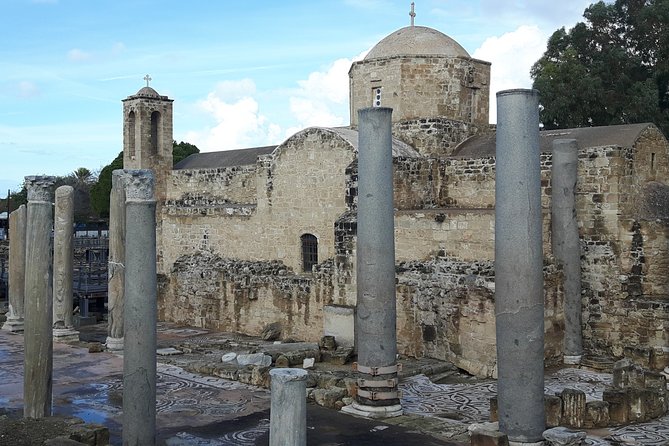
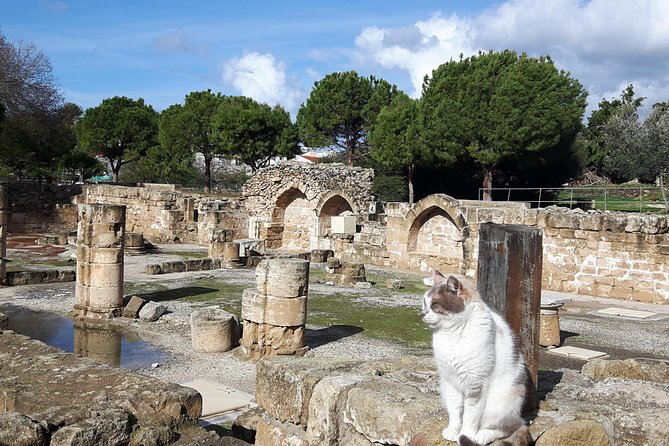
This stop blends early Christian significance with surviving art. You spend about 35 minutes at the Church of Agia Kyriaki and the St. Paul area. Admission is free.
The core setup is that there was one of the biggest and oldest basilicas and an episcopal palace here, but it was destroyed during Arab raids. What remains that you can see is the floor mosaics from as far back as 4 AD. Even in a short visit, those mosaics anchor the whole site. They give you a concrete sense of what the interior must have felt like.
Then comes the St. Paul connection. You can see a pillar associated with a story where St. Paul was flogged 39 times by the Roman governor Sergious before converting to Christianity. A good guide will pace this part carefully, because it is easy to get lost in names and numbers. But if your guide is doing it well, you will leave with the basic sequence and the historical meaning.
The value here is that you are not just looking at ruins. You are learning how belief systems and power structures intersected in the same physical space.
Stop 5: Tombs of the Kings, Doric Columns, and What We Cannot Prove
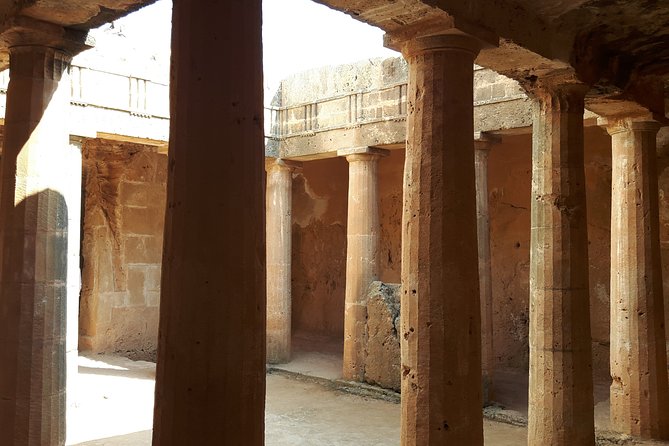
Your final major site is the Tombs of the Kings. Plan about 1 hour. Admission is not included, so again, you may pay separately.
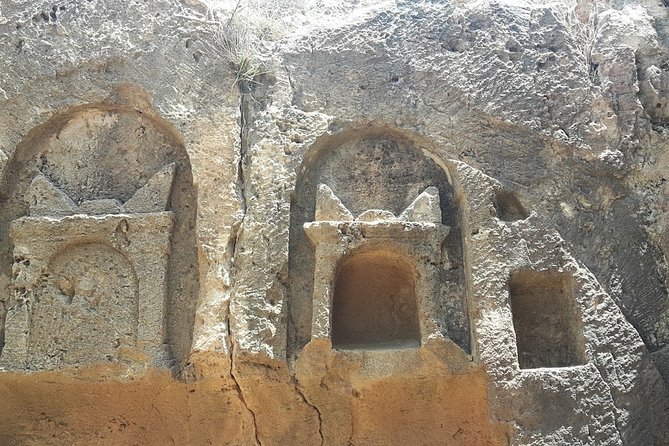
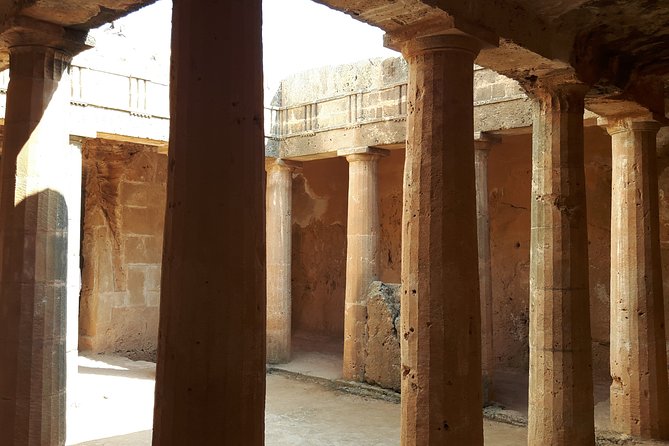
This is one of those places where tourism often repeats a label, but the facts are more careful. There is no proof these tombs were actually royal. Instead, the belief is that a local privileged class was buried here around 3 BC. What matters is that the site covers a massive area, so even within an hour you can feel how large it is.
You will notice Doric-style columns carved from rock. That detail is important because it shows an architectural language meant to communicate status and permanence. The columns make the site feel designed, not accidental.
The real benefit of having a guide here is balancing romance with evidence. If you come in expecting a fully confirmed royal burial story, you may be surprised by the uncertainty. That uncertainty is not a downside. It is actually what makes the visit feel honest.
Price and Value for a Private Tour Up to 4 People
The listed price is $576.76 per group, up to 4 people, for about 6 to 7 hours. That can sound steep if you compare it to a public bus day. But compare it to what you are buying: transport from Nicosia to Paphos and back, a professional guide, bottled water, and entrance tickets where the tour indicates they are included.
For value, the biggest factor is group size. If you are traveling solo, it costs more per person than a shared group bus would. But if you split it between two or four people, it often becomes easier to justify, especially when you include the time savings of not driving yourself in Cyprus.
Also, bottled water and guidance are not fluff. When you are moving through multiple stops, a guide helps you make sense of why each site is placed where it is. That turns a list of landmarks into a coherent day.
One more practical note: this tour tends to be booked about 10 days in advance on average. If your dates are fixed, it is worth reserving earlier rather than hoping.
How the Guided Flow Shapes Your Experience
The schedule is designed to keep the day from feeling random. You start with a quick myth marker, then hit the harbour for atmosphere, then a castle for the political timeline, then a church site for mosaics and early Christian story, and finish with the tomb complex for scale and architecture.
You also get a day that is heavy on outside spaces, but not so heavy that you are out all day. That is why 6 to 7 hours is such a sweet spot for many visitors from Nicosia. It is long enough to feel like you went somewhere meaningful, short enough that you can still enjoy the evening after.
A strong sign this tour is run well is the way the guide supports you with context and answers questions. In particular, guides like Sirin often add details that connect Cyprus history to the sites you see, like explanations about the 1974 split of Cyprus and why Famagusta is commonly described as a ghost town. That kind of linking makes the day stick, even after you leave the monuments behind.
Best Fit: Who This Tour Suits, and Who Might Want a Different Plan
This works best if you want:
- A guided day trip without needing to drive
- An introduction to Paphos that includes Greek myth plus real archaeology
- A private setting where you can ask questions and move at the pace of your group
It might not be the best fit if you want to spend long stretches only at one site. Tombs of the Kings and the Harbour Castle do require separate admission, and the time per stop is limited. You will see the essentials, but you will not have unlimited hours for deep wandering.
If your goal is to turn Paphos into a full multi-day archaeology binge, you would likely need a different plan with more time on the ground. But for a single day from Nicosia, this itinerary is a solid match.
Should You Book the Ancient City of Paphos Tour?
Book it if you want a structured, efficient day that blends myth and archaeology in a way you can actually follow. I like that the tour handles transport and guiding, and I like that it gives you both the playful Aphrodite’s Rock moment and the more grounded remains like the 4 AD mosaics at Agia Kyriaki.
Skip it or consider a different option if you strongly prefer to linger for long periods at fewer sites. This is not that type of day. It is a “see the key pieces and understand them” format, with good comfort and clear routing.
FAQ
How long is the Ancient City of Paphos experience?
It runs about 6 to 7 hours.
Where does the tour start?
The meeting point is the Ledra Palace Checkpoint in Lefkoşa, at İkinci Selim Cd 37h, Lefkoşa 99010.
What time does the tour start?
The start time is 9:00 am.
Is this a private tour?
Yes. Only your group participates.
How many people are in a group?
The tour price is per group, up to 4 people.
Is pickup included?
Pickup is offered.
What language is the tour guide?
The tour is offered in English.
What does the price include?
It includes transfer, fuel, parking, guidance, bottled water, and entrance tickets for historical sites where listed as included.
Is lunch included?
No. Lunch is not included.
Which stops have admission not included?
Paphos Harbour Castle and Tombs of the Kings show admission ticket not included.
What is the cancellation rule if plans change?
You can cancel for free. You can cancel up to 24 hours in advance for a full refund, and refunds are not available if you cancel less than 24 hours before the experience starts.
Just reviewed around Nicosia
- FROM PAPHOS: Nicosia free time for shopping & sightseeing★ 5.0 · 3 reviews
- From Nicosia: Paphos Full-Day Private Tour with Guide★ 5.0 · 3 reviews
- Nikosia : Best of North Nicosia Walking Tour★ 4.8 · 4 reviews
- Nicosia Larnaka Lefkara Tour from Ayia Napa/Protaras/Larnaka★ 3.7 · 4 reviews
- NICOSIA Day trip by bus with French-speaking guide★ 3.6 · 4 reviews
- Nicosia Walled City Bike Tour★ 5.0 · 4 reviews
- From Nicosia, Kyrenia & Famagusta- 3 Cities in oneday Tour★ 5.0 · 4 reviews
- Nikosia : Private Custom Walking Tour with A Guide (Private Tour)★ 5.0 · 4 reviews
City Tours, compared.
FAB Private Customized Tours Cyprus from Larnaca city
Read our review →

Private Transfer: Larnaca Airport to Limassol City 1-14 pax
Read our review →
Browse the lists this tour appears in